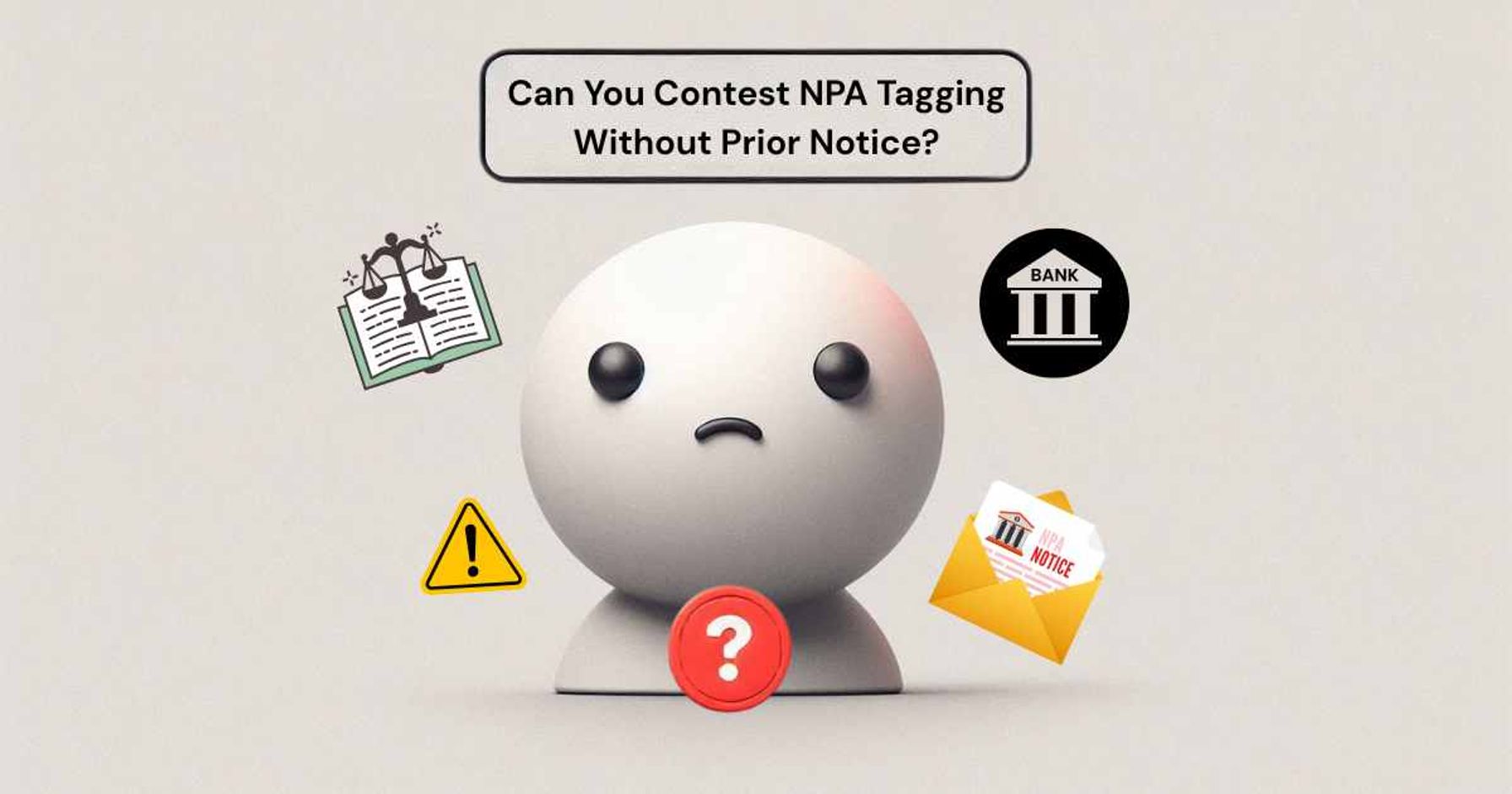
In the Indian financial ecosystem, a nonperforming asset (NPA) is an advance or loan for which the interest or principal payment due within the last 90 days has not been paid. When a loan account becomes an NPA, it instantly affects the borrower’s credit status and can lead to aggressive techniques, legal litigation, and security forfeiture.
But what can happen when your account is labelled as an NPA without communication or any signals? Is it something that you could legally argue with? The answer is yes—but under certain conditions.
What Does the Legal Code Provide on Classification of NPA?
Through the Master Circular on Prudential Norms in Income Recognition, Classification of Assets including NPAs and Provisioning by the Reserve Bank of India (RBI), a detailed guideline has been provided in terms of asset classification.
According to these norms, the banking institutions must provide reasonable and adequate time to the borrowers, to reclassify their accounts under NPA or under recovery actions under the SARFAESI Act, 2002.
Such notice is not formal; it is a legal requirement. It should be done in writing and the borrowers should also be provided with the chance to regularize their account or question it.
When a bank does not follow the process, it may be regarded to be operating against natural justice and RBI standards.
Legal Solutions to mislabelling of NPA
1. Address the Bank
It is mandatory to compose a formal representation or an objection to the concerned bank. This presentation must explain:
● Any discrepancies
● Failure of notice
● Lapse in procedures
● Demand redistribution of the classification
2. Approach the Banking Ombudsman
In case of inadequate response of the bank within 30 days, the borrower may reach the Banking Ombudsman under the Integrated Ombudsman Scheme, 2021 of RBI.
The Ombudsman has the power to:
● Examine the complaint
● Instruct the bank to reverse the NPA classification
● Grant compensation to the borrower for any damage incurred
3. File a Complaint in the Consumer Forum
Another remedy that proves advantageous (when the borrower is not a company or a firm) is filing a case with the Consumer Disputes Redressal Commission.
In many cases, wrongful NPA tagging has been upheld by courts as:
● An unfair trade practice
● A deficiency in service
● A cause of reputational or financial harm
4. Move the Debt Recovery Tribunal (DRT)
Borrowers may also challenge the bank’s action before the Debt Recovery Tribunal if the bank has taken the following initial steps under the SARFAESI Act:
● Taking possession
● Auctioning of assets
Under Section 17 of the SARFAESI Act, the borrower has the right to appeal and challenge the tagging of NPAs.
RBI Directions and Case Laws
The Fair Practices Code of RBI requires that banks follow due process before taking recovery or classification steps.
This has also been upheld by courts. For instance:
● In Indian Overseas Bank vs. M/S Industrial Chain Concern, the court stated that banks cannot arbitrarily declare NPAs without due notice and a chance for the borrower to respond.
● In Transcore vs. Union of India (2006), the Supreme Court approved that borrowers can challenge procedural lapses that impact asset classification and recovery processes.
What Should At-Risk Borrowers Do?
If you think your loan has been wrongly classified as an NPA:
● Immediately demand account statements and NPA classification documents from the bank
● File a formal complaint with the grievance redressal officer
● Keep records of all communication
● Seek legal advice for further action through courts or tribunals
Conclusion
Unilateral tagging of NPA without due notice is not just unfair, it is legally challenging. Borrowers in India have legal rights and access to various forums to protect their credit standing.
Banks must operate within fair procedures and the rule of law. If you ever face wrongful NPA classification, speak up, act fast, and protect your financial identity.